Positioning Ugliness to Emphasize Beauty
It all started with a palm tree…




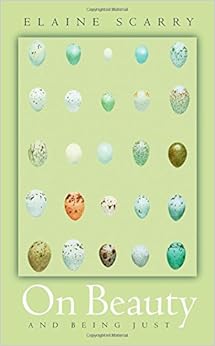
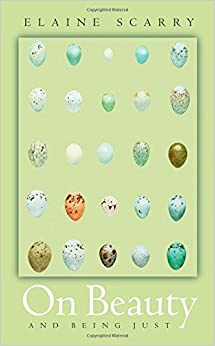
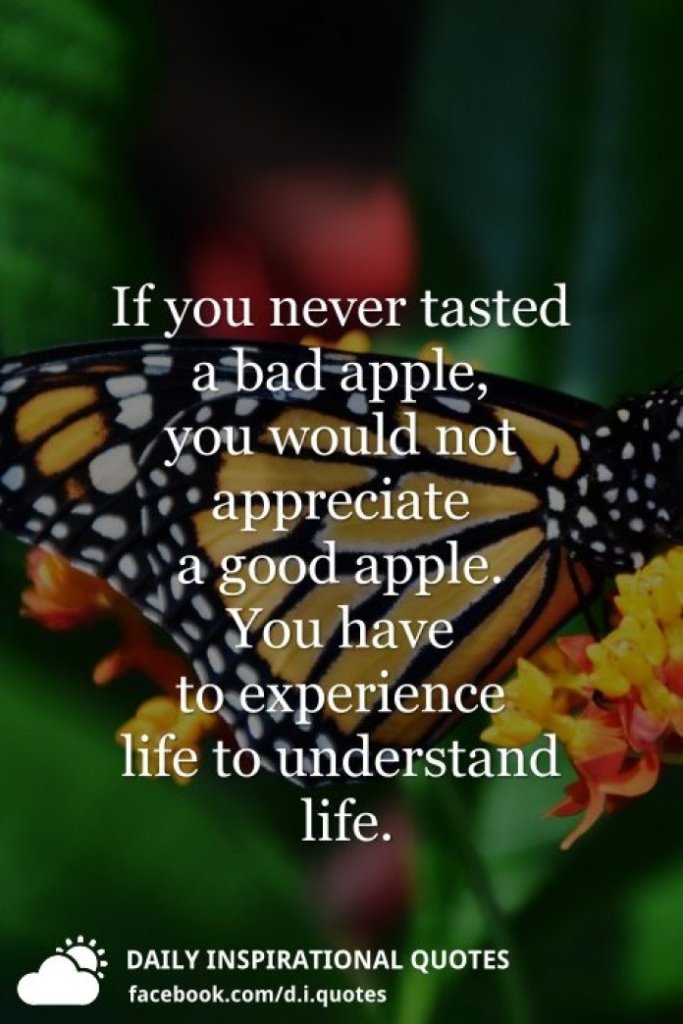
Close your eyes and imagine a beautiful sky: a light breeze gently corralling puffy, robust clouds along the bright blue Heavens. Now ask yourself: Would these “Heavens” be so divine without the visual foil of their monstruous opposite, a “Hell” with which to compare them to? The appreciation of beauty lies at the behest of likewise recognizing the ugly. With that, I argue that beauty is all about symmetry and balance- a notion that is often strived for in the realm of Philosophy. Elaine Scarry, Professor of Aesthetics at Harvard University, touches on the themes of balance and symmetry in her essay-like book, On Beauty and Being Just. While mainly addressing and refuting political claims against beauty, Scarry puts into philosophical terms the significance of the ugly by showing that it—in essence—works together with beauty to create a comparative contrast. In the book, the author stresses the compensation that beauty requires via constant/circular effects, a thirst for balance, and the necessity of symmetry; this has led me to determine that embracing the ugly, as an intensifying tool, accentuates beauty’s strength.

Continuing Beauty in Life
In the Professor’s first section of the philosophical dive, “On Beauty and Being Wrong,” she addresses the significance of “replication” or “begetting”- something that she refers to as beauty’s effect on us as an “impulse toward creation” (9). This perpetual desire of continuing beauty in life, art, and thoughts reminds me of the circular, symmetrical rhythm that beauty demands. The author suggests that beauty is “life-affirming, life-giving,” and that “you will feel its removal as a retraction of life” (27). I say that it is the feeling of that “retraction of life” which generates the true appreciation of beauty; without the cavernous void that its withdrawal creates, it becomes challenging to welcome beauty in its entirety. This circle is not broken, however, once beauty is lost, but continues an unrelenting appetite for it, repeating beauty’s cycle since—as Scarry indicates in agreeance with Kant—“the pleasure we take [and wish to recreate] in beauty is inexhaustible” (50). Simply, the void is considered less of an emptiness and more of a highlighter, emphasizing life’s most important—although at the time missing—component: the balance of beauty.
In search for balance, we must remember that beauty is valued visually, emotionally, mindfully, etcetera. It is important to realize how comparing beauty to ugliness triggers a perfect equilibrium; we must also understand each’s place in being. In Part Two, “On Beauty and Being Fair,” Scarry lays out the elements of the symmetrical features of beauty- not just in an aesthetic sense, but universally as well. The author negates the political argument that beauty distracts us from injustice by claiming the opposite—she states that it allows us to fully recognize injustice by comparison—I agree with this totally. It is the symmetrical force of the push and pull between justice and injustice that make each so; without one, the meaning (or rather) existence of the other essentially dissipates. She asserts that: “beautiful things assist us in remedying injustice” (80). Here, the implication is that we need to see each side of the coin to recognize the full value of both beauty/justice and ugliness/injustice. Basically, in examining both extremes, the balance we strive for internally as well as externally is often found.

Courtesy: https://www.pinterest.com/pin/300404237621691609/

“Beauty brings copies of itself into being.”
Elaine Scarry




The Symmetry of Lacking and Abundance
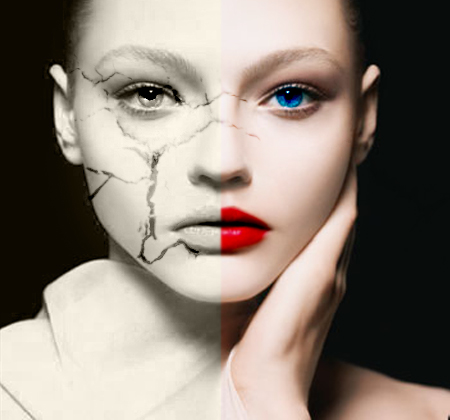
It is unrealistic to showcase the influences of the balance between beauty and ugliness without mentioning beauty’s—and implicitly our—need for symmetry. Scarry claims that “the absence of beauty is a profound form of deprivation” (118). Again, I say that it is in the “deprivation,” the craving of beauty, that makes the beautiful reach its maximum potential. The symmetry of lacking and abundance is what comes to mind. Is it true that a greasy cheeseburger harnesses vast admiration following desolate hunger? Of course, it is. Would an identical grilled masterpiece hold the same title if your belly is full to the brim? No, it absolutely would not; in fact, it might even be looked at with intense disgust. How is this so? It is the explicit absence of beauty—in this case the burger/food—that makes one relish in its deliciousness (attractiveness); without hunger there is no fulfillment, and without ugliness there is no beauty. As Scarry says: “when both terms of an analogy are present, the analogy is inert” (109). So, in the least, the pleasure of beauty is ultimately amplified by cherishing its void, and it is without beauty that we recognize its definitive power and significance. The relationship between the two extremes create a symmetry that, as a reminder, we all seek- one that balances our sense of self and allows the joys of beauty to be magnified while also marking its true worth.
Continuing thoughts on symmetrical forces, Scarry approaches the ideals encompassed by the influence of balance on political and social elements. She proposes that: “in periods when justice has been taken away, beautiful things […] hold steadily visible the manifest good of equality and balance” (97); to add, “the soul is in quest of nothing except equality and similitude” (99). Here, she is referencing how beauty/justice and ugliness/injustice are entities that are balanced by the offset of the other- a symmetry vital in the social/political (as well as spiritual) realm. She bears witness to the fact that “equality is the heart of beauty […] equality is pleasure-bearing […and…] Beautiful things please by proportion” (98). In agreeance, I supplement her thoughts by saying that without balance and symmetry, social or political disturbances would prove difficult to identify. How would an impoverished child recognize that he/she is disadvantaged if they have only known isolated poverty? How would a fully satisfied child understand need without something to compare the feeling to? It works both ways. It is in the symmetry that each is discovered, that each is comparative, and that each is understood/appreciated; the foil makes all the difference, both for beauty and in the absence of it.
Embrace the Ugly
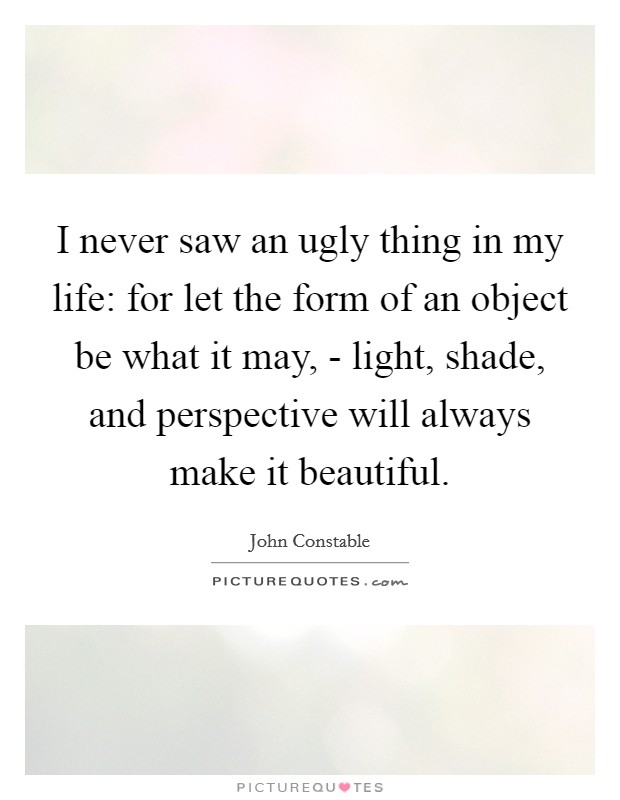
So what? What does this all mean? As beauty and justice “often converge” (111), it is understood that beauty “assists in turning us to justice” (109). That said, ugliness and the void of beauty—the symmetrical force of the other—also persuades us to underscore injustice. I employed in my introduction a similar notion of Scarry’s example of a perpetual beautiful sky (119-120)- an occurrence I could not fathom being appreciated as much as one that is contrasted with an unsightly sky. In the margins of page 120, I penned the question: “If it’s always nice, is it still beautiful?” No- recognizing ugliness is necessary to conveying a stronger sense of beauty, strengthening its force. Not that you cannot appreciate beauty simply as just that, merely it is in the comparison to its rival (and often its void) where beauty’s power truly lies. In revisiting my (and elongating Scarry’s) thoughts: Without ugliness, is there beauty? Without injustice, is there justice? They may be there somewhere, hidden under the guise of normalcy, but inevitably it will take alternate appraisal to become renowned in their own right- the balance/symmetry of beauty and ugliness, justice and injustice is what heightens each’s severe potency. So, embrace the ugly- because the power of beauty lies in its comparison.

Recognizing ugliness is necessary to conveying a stronger sense of beauty, strengthening its force.

“Beauty quickens. It adrenalizes….At the moment one comes into the presence of something beautiful, it greets you.”
-Elaine Scarry

Follow Me
Input Email. Gain Insight.
 Fused Together, Creating a Triad of Insight